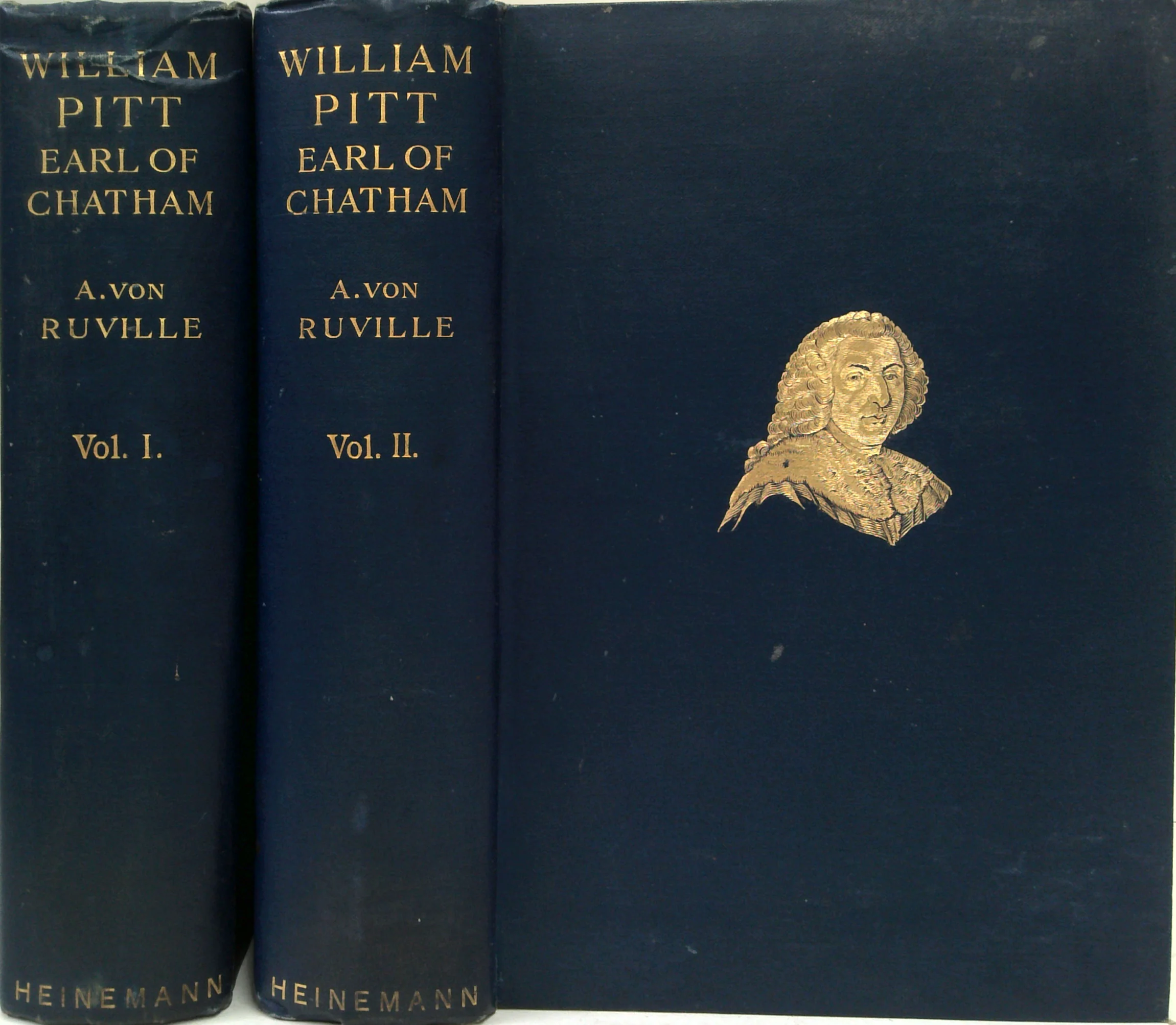
William Pitt, Earl Of Chatham (Two-Volume Set)
Author: Albert Von Ruville
Binding: Hardback
Published: William Heinemann; G. P. Putnam's Sons, 1907
Condition:
Book: Fair
Jacket: No dust jacket - some marks on spine and corners
Pages: Tanning and foxing
Markings: No markings
Condition remarks: Vol. II - prelims loose.
This substantial two volume biography in the genre of political history presents a commanding study of William Pitt, Earl of Chatham, one of Britain’s most influential statesmen of the eighteenth century. Albert von Ruville details Pitt’s rise to prominence, his parliamentary battles, and his decisive role in shaping imperial policy during a period of expanding global power. The narrative illustrates the interplay between Pitt’s oratory, his strategic vision, and the political rivalries that defined his career. It argues for his enduring significance in establishing Britain’s leadership on the world stage, while also uncovering the personal convictions and conflicts that marked his tenure.
Product Information
Product Information
Shipping & Returns
Shipping & Returns
Description
Author: Albert Von Ruville
Binding: Hardback
Published: William Heinemann; G. P. Putnam's Sons, 1907
Condition:
Book: Fair
Jacket: No dust jacket - some marks on spine and corners
Pages: Tanning and foxing
Markings: No markings
Condition remarks: Vol. II - prelims loose.
This substantial two volume biography in the genre of political history presents a commanding study of William Pitt, Earl of Chatham, one of Britain’s most influential statesmen of the eighteenth century. Albert von Ruville details Pitt’s rise to prominence, his parliamentary battles, and his decisive role in shaping imperial policy during a period of expanding global power. The narrative illustrates the interplay between Pitt’s oratory, his strategic vision, and the political rivalries that defined his career. It argues for his enduring significance in establishing Britain’s leadership on the world stage, while also uncovering the personal convictions and conflicts that marked his tenure.