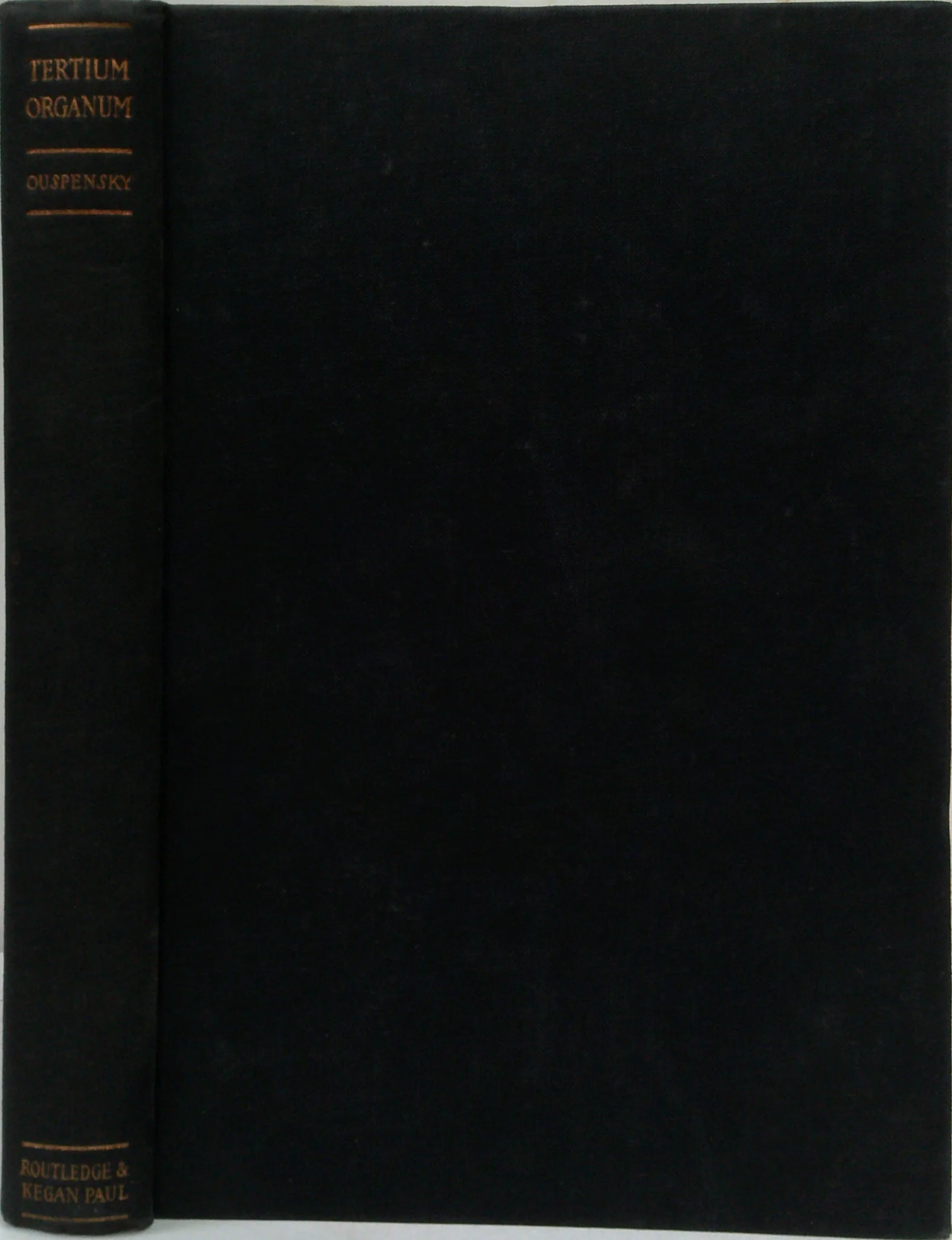
Tertium Organum: The Third Canon Of Thought A Key To The Enigmas Of The World
Author: P. D. Ouspensky. Translated from the russian by Nicholas Bessaraboff and Claude Bragdon. With an introduction by Claude Bragdon.
Binding: Hardback
Published: Routledge and Kegan Paul, London, 1957
Condition:
Book: Fair
Jacket: No dust jacket - some marks on spine and corners
Pages: Tanning and foxing
Markings: Previous owner
Condition remarks: Fold-out table intact.
This profound philosophical treatise, Tertium Organum, presents a radical reinterpretation of human perception and reality. It argues for the existence of higher dimensions and a more expansive understanding of consciousness, challenging conventional scientific and spiritual paradigms. Ouspensky’s work illustrates a complex system of thought, guiding readers through intricate concepts of time, space, and the nature of being. The text maintains an academic yet accessible tone, inviting contemplation on the limits of ordinary experience. It chronicles a journey into esoteric knowledge, offering a unique perspective on the universe and humanity's place within it.
Product Information
Product Information
Shipping & Returns
Shipping & Returns
Description
Author: P. D. Ouspensky. Translated from the russian by Nicholas Bessaraboff and Claude Bragdon. With an introduction by Claude Bragdon.
Binding: Hardback
Published: Routledge and Kegan Paul, London, 1957
Condition:
Book: Fair
Jacket: No dust jacket - some marks on spine and corners
Pages: Tanning and foxing
Markings: Previous owner
Condition remarks: Fold-out table intact.
This profound philosophical treatise, Tertium Organum, presents a radical reinterpretation of human perception and reality. It argues for the existence of higher dimensions and a more expansive understanding of consciousness, challenging conventional scientific and spiritual paradigms. Ouspensky’s work illustrates a complex system of thought, guiding readers through intricate concepts of time, space, and the nature of being. The text maintains an academic yet accessible tone, inviting contemplation on the limits of ordinary experience. It chronicles a journey into esoteric knowledge, offering a unique perspective on the universe and humanity's place within it.