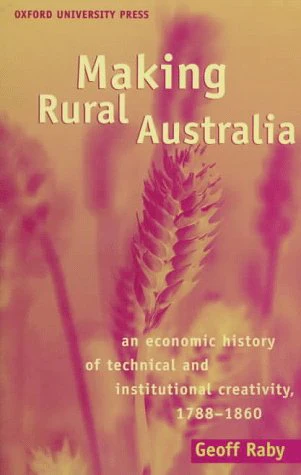
Making Rural Australia
Making Rural Australia challenges two common by contradictory views of Australian history. One is the 'fatal shore': Australia was a place of horrible destitution and those miserable beginnings set the course for Australia of today. The other is the 'lucky country': European settlement began in a bountiful Arcadia and so wealth and prosperity have simply flowed forth, stifling creativity and technical and scientific endeavour. The book argues that successful European settlement of Australia owed a lot to its prodigious natural resources and to the technical and institutional creativity at the time. Australian farmers are shown to be adaptable and innovative. Such creativity was essential for the profitable exploitation of the land's riches. Early Australian agriculture looked slovenly and inefficient to European visitors. It was in fact a creative response to the economic and ecological challenges of occupying the continent. English farming practice is shown to have been an irrelevant standard by which to judge the efficiency of rural Australia. Australian farmers drew on the stock of global technical knowledge. Distance and information costs were not major obstacles to the rapid d
Original: $8.47
-70%$8.47
$2.54Product Information
Product Information
Shipping & Returns
Shipping & Returns
Description
Making Rural Australia challenges two common by contradictory views of Australian history. One is the 'fatal shore': Australia was a place of horrible destitution and those miserable beginnings set the course for Australia of today. The other is the 'lucky country': European settlement began in a bountiful Arcadia and so wealth and prosperity have simply flowed forth, stifling creativity and technical and scientific endeavour. The book argues that successful European settlement of Australia owed a lot to its prodigious natural resources and to the technical and institutional creativity at the time. Australian farmers are shown to be adaptable and innovative. Such creativity was essential for the profitable exploitation of the land's riches. Early Australian agriculture looked slovenly and inefficient to European visitors. It was in fact a creative response to the economic and ecological challenges of occupying the continent. English farming practice is shown to have been an irrelevant standard by which to judge the efficiency of rural Australia. Australian farmers drew on the stock of global technical knowledge. Distance and information costs were not major obstacles to the rapid d