Robert de Cotte and the Perfection of Architecture in
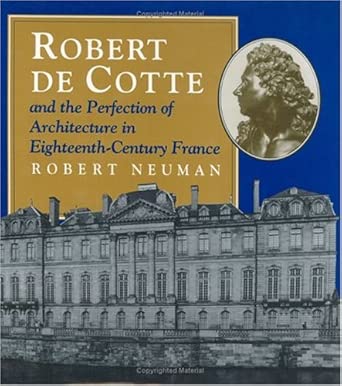
Robert de Cotte (1656/7-1735), principal architect to the King of France, was a prominent European architect. In a period that witnessed the ascendancy of Paris over Rome as the international centre of fashion, princes and nobles in Germany, Italy and Spain commissioned him to design buildings in the French court style. Robert Neuman provides an examination of 50 or so building projects by de Cotte, which include such works as the Hotel d'Estrees, Paris; Schloss Poppelsdorf, Bonn; and the Palais Rohan, Strasbourg. After describing de Cotte's training and the professional context in which he worked, Neuman offers a survey of de Cotte's output. For each commission, he recreates the actual design process, showing how de Cotte manipulated an accepted vocabulary of architectural forms to meet the patron's specific requirements. De Cotte's own drawings and quotations from a variety of contemporary writings supplement the case histories.
Original: $42.35
-70%$42.35
$12.71Product Information
Product Information
Shipping & Returns
Shipping & Returns
Description
Robert de Cotte (1656/7-1735), principal architect to the King of France, was a prominent European architect. In a period that witnessed the ascendancy of Paris over Rome as the international centre of fashion, princes and nobles in Germany, Italy and Spain commissioned him to design buildings in the French court style. Robert Neuman provides an examination of 50 or so building projects by de Cotte, which include such works as the Hotel d'Estrees, Paris; Schloss Poppelsdorf, Bonn; and the Palais Rohan, Strasbourg. After describing de Cotte's training and the professional context in which he worked, Neuman offers a survey of de Cotte's output. For each commission, he recreates the actual design process, showing how de Cotte manipulated an accepted vocabulary of architectural forms to meet the patron's specific requirements. De Cotte's own drawings and quotations from a variety of contemporary writings supplement the case histories.