🎉 Up to 70% Off Selected ItemsShop Sale
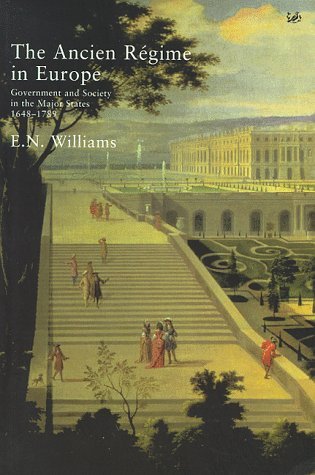
The Ancien Regime In Europe
NB: This is a secondhand book in very good condition. See our FAQs for more information. Please note that the jacket image is indicative only. A description of our secondhand books is not always available. Please contact us if you have a question about this title.
Author: E.N Williams
Format: Paperback
Number of Pages: 624
Frederick the Great declared that there were seven major powers in Europe - Holland, Spain, France, Russia, Prussia, Austria and Britain. Some of these were of merely European significance, others were world empires. Taking each power in turn, E. N. Williams examines its fundamental strengths and weaknesses. By concentrating on the internal history of each state, he penetrates the inner workings of its government and economy and reveals the complexity of its social system. He highlights the struggles between innovation and tradition which charactise this period, between the absolute monarchs and the ancient liberties of the clergy and nobles, between capitalism in commerce and industry and the old agrarian way of life. The result is a comprehensive and fascinating survey of eighteenth-century Europe. `It is by far the best textbook available. 'TES
Author: E.N Williams
Format: Paperback
Number of Pages: 624
Frederick the Great declared that there were seven major powers in Europe - Holland, Spain, France, Russia, Prussia, Austria and Britain. Some of these were of merely European significance, others were world empires. Taking each power in turn, E. N. Williams examines its fundamental strengths and weaknesses. By concentrating on the internal history of each state, he penetrates the inner workings of its government and economy and reveals the complexity of its social system. He highlights the struggles between innovation and tradition which charactise this period, between the absolute monarchs and the ancient liberties of the clergy and nobles, between capitalism in commerce and industry and the old agrarian way of life. The result is a comprehensive and fascinating survey of eighteenth-century Europe. `It is by far the best textbook available. 'TES
$7.06
The Ancien Regime In Europe—
$7.06
Product Information
Product Information
Shipping & Returns
Shipping & Returns
Description
NB: This is a secondhand book in very good condition. See our FAQs for more information. Please note that the jacket image is indicative only. A description of our secondhand books is not always available. Please contact us if you have a question about this title.
Author: E.N Williams
Format: Paperback
Number of Pages: 624
Frederick the Great declared that there were seven major powers in Europe - Holland, Spain, France, Russia, Prussia, Austria and Britain. Some of these were of merely European significance, others were world empires. Taking each power in turn, E. N. Williams examines its fundamental strengths and weaknesses. By concentrating on the internal history of each state, he penetrates the inner workings of its government and economy and reveals the complexity of its social system. He highlights the struggles between innovation and tradition which charactise this period, between the absolute monarchs and the ancient liberties of the clergy and nobles, between capitalism in commerce and industry and the old agrarian way of life. The result is a comprehensive and fascinating survey of eighteenth-century Europe. `It is by far the best textbook available. 'TES
Author: E.N Williams
Format: Paperback
Number of Pages: 624
Frederick the Great declared that there were seven major powers in Europe - Holland, Spain, France, Russia, Prussia, Austria and Britain. Some of these were of merely European significance, others were world empires. Taking each power in turn, E. N. Williams examines its fundamental strengths and weaknesses. By concentrating on the internal history of each state, he penetrates the inner workings of its government and economy and reveals the complexity of its social system. He highlights the struggles between innovation and tradition which charactise this period, between the absolute monarchs and the ancient liberties of the clergy and nobles, between capitalism in commerce and industry and the old agrarian way of life. The result is a comprehensive and fascinating survey of eighteenth-century Europe. `It is by far the best textbook available. 'TES